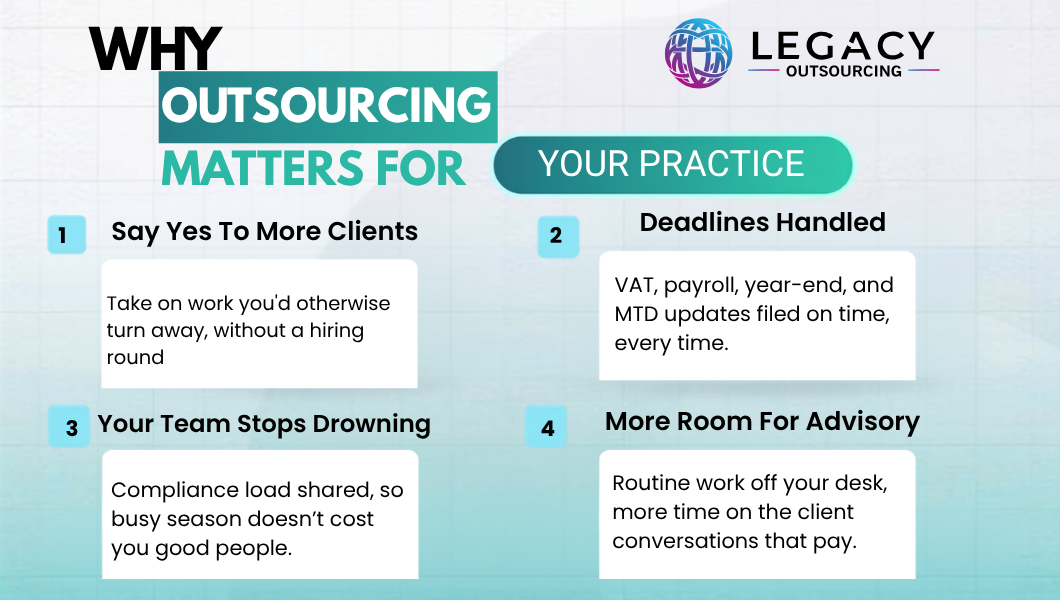

This section explains how outsourcing will reshape business efficiency in 2025 for UK companies by improving productivity, reducing costs, and enabling access to specialised expertise
- How Outsourcing Will Reshape Business Efficiency in 2025 for UK Companies
- The UK Business Climate Is Forcing Operational Change
- Efficiency Is No Longer About Cost — It’s About Structure
- Structured Workflows Replace Manual Bottlenecks
- Compliance Alignment Reduces Disruption
- Financial Visibility Drives Smarter Decisions
- Leadership Focus Becomes a Competitive Advantage
- Scalability Without Increasing Fixed Overhead
- Reducing Operational Risk Enhances Stability
- The Bigger Shift: From Reactive to Proactive Operations
- Final Thought
- FAQs
How Outsourcing Will Reshape Business Efficiency in 2025 for UK Companies
Efficiency in 2025 will not be defined by how hard businesses work.
It will be defined by how intelligently they operate.
UK companies are facing a unique combination of pressures:
- Rising employer National Insurance contributions
- Wage inflation
- Increasing regulatory oversight
- Ongoing HMRC compliance requirements
- Digital transformation expectations
- Talent shortages in finance and operations
In this environment, efficiency is no longer about cutting corners.
It is about building structured, scalable systems.
And outsourcing is becoming one of the most powerful tools to achieve that.
The UK Business Climate Is Forcing Operational Change
The UK market in 2025 demands resilience.
Companies must manage:
- VAT obligations and reporting cycles
- PAYE and payroll compliance
- Pension auto-enrolment regulations
- Data protection standards (GDPR)
- Cash flow stability in uncertain economic conditions
Internal teams are stretched.
Manual processes still exist.
Leadership bandwidth is limited.
Without operational redesign, inefficiencies multiply.
Outsourcing offers a structural solution not just temporary relief.
Efficiency Is No Longer About Cost — It’s About Structure
Traditional outsourcing was often seen as a cost-saving tactic.
In 2025, that perception is outdated.
Modern outsourcing focuses on:
- Process optimisation
- Defined workflows
- Accountability systems
- Risk control
- Financial visibility
- Scalability
Efficiency improves when execution becomes disciplined.
Disciplined execution requires structure.
Structure is what strategic outsourcing delivers.
Structured Workflows Replace Manual Bottlenecks
As UK companies grow, finance operations often become reactive.
Invoices are processed but not consistently monitored.
Approvals occur but documentation lacks clarity.
Payroll runs but reconciliation pressure increases.
At Legacy Outsourcing, finance functions such as accounts payable and payroll are built around defined workflows, approval hierarchies, and exception management systems.
Well-designed outsourced accounts payable services embed control into execution.
The objective is not just faster processing but:
- Fewer exceptions
- Clearer accountability
- Stronger compliance alignment
Invoices follow structured pathways.
Responsibilities are clearly assigned.
Audit trails are preserved.
Efficiency improves when operational chaos is replaced with defined systems.
Compliance Alignment Reduces Disruption
UK businesses operate within a strict regulatory framework.
Compliance failures can result in:
- Financial penalties
- HMRC investigations
- Reputational damage
- Operational disruption
Smart outsourcing embeds compliance into daily execution.
Deadlines are tracked.
Reports are structured.
Documentation is maintained.
Compliance becomes routine rather than reactive.
Routine processes reduce stress.
Reduced stress improves efficiency.
Financial Visibility Drives Smarter Decisions
Efficiency depends on clarity.
Without accurate reporting and structured financial oversight, companies struggle to:
- Forecast accurately
- Manage supplier payments
- Monitor cash flow
- Identify cost inefficiencies
Outsourcing strengthens financial reporting systems.
Leadership gains access to timely, reliable insights.
When decisions are based on clarity, efficiency improves across the organisation.
Leadership Focus Becomes a Competitive Advantage
One of the greatest efficiency leaks in UK companies is leadership distraction.
When directors spend time:
- Managing invoice approvals
- Resolving payroll discrepancies
- Fixing reconciliation errors
- Handling administrative backlogs
They lose focus on:
- Business growth
- Strategic partnerships
- Innovation
- Market positioning
Outsourcing removes operational noise.
Clear leadership focus drives stronger organisational performance.
Scalability Without Increasing Fixed Overhead
Hiring internally in 2025 carries significant cost implications:
- Higher salary expectations
- Increased employer NI contributions
- Pension obligations
- Recruitment costs
- Training investment
Outsourcing provides flexible operational capacity.
As transaction volume grows, support scales accordingly.
As market conditions shift, cost structures remain manageable.
Efficiency improves when businesses avoid unnecessary structural weight.
Reducing Operational Risk Enhances Stability
Inefficiency often hides inside preventable errors:
- Duplicate payments
- Missed filing deadlines
- Cash flow miscalculations
- Inconsistent documentation
Smart outsourcing reduces these risks through:
- Defined controls
- Structured escalation processes
- Transparent reporting
- Consistent monitoring
Risk reduction strengthens operational resilience.
Resilience protects efficiency.
The Bigger Shift: From Reactive to Proactive Operations
In 2025, successful UK companies will shift from reactive management to proactive execution.
Outsourcing enables this shift by:
- Embedding process discipline
- Strengthening reporting frameworks
- Aligning compliance with execution
- Supporting leadership clarity
- Enabling scalable infrastructure
Efficiency is no longer about working faster.
It is about working smarter within structured systems.
Final Thought
The real question UK businesses must ask is:
“Are our internal systems designed to operate efficiently at scale?”
Outsourcing in 2025 is not about replacing teams.
It is about strengthening infrastructure.
Because growth without efficiency creates pressure.
Efficiency with structure creates stability.And stability is what reshapes business performance.
FAQs: Outsourcing & Business Efficiency in the UK
Why is outsourcing becoming more important for UK companies in 2025?
Rising employer costs, regulatory complexity, and talent shortages require flexible, structured operational models.
Does outsourcing reduce control over business operations?
No. Structured outsourcing often increases accountability, transparency, and reporting clarity.
Which functions are most commonly outsourced?
Accounts payable, payroll, bookkeeping, compliance support, HR administration, and operational back-office functions.
Is outsourcing suitable for SMEs in the UK?
Yes. SMEs benefit from scalable expertise without the financial burden of expanding internal teams.
How does outsourcing improve efficiency?
By reducing manual bottlenecks, embedding compliance controls, improving financial visibility, and protecting leadership focus.
References
Legacy Outsourcing: Supporting Smarter Business Growth
As outsourcing shifts from a tactical solution to a strategic growth engine, choosing the right partner becomes more crucial than ever. At Legacy Outsourcing, we help businesses reduce costs, improve efficiency, and scale sustainably.
Whether you’re exploring outsourcing for the first time or ready to expand your remote team, we’re here to help.
– Get in touch with us at: info@legacyoutsourcing.co.uk
– Follow our journey on LinkedIn and Instagram for weekly tips and stories.
🔗 Visit our website: Legacy Outsourcing