
This section explores whether BPO services are truly only for large corporations and explains how businesses of all sizes can benefit from flexible and scalable outsourcing solutions.
- Myth: BPO Services Are Only for Large Corporations
- Fact: Modern BPO Is Built for Scalability
- What Has Changed in the BPO Landscape?
- Related Blog
- How BPO Strengthens Process Control
- Why SMEs Often See Greater Impact
- When Should a Business Consider BPO?
- Final Verdict: Myth or Fact?
- FAQs
When businesses hear the term BPO (Business Process Outsourcing), the image that often comes to mind is a global enterprise outsourcing entire departments across multiple countries.
It feels large-scale.
Corporate.
Complex.
Which leads to a common assumption:
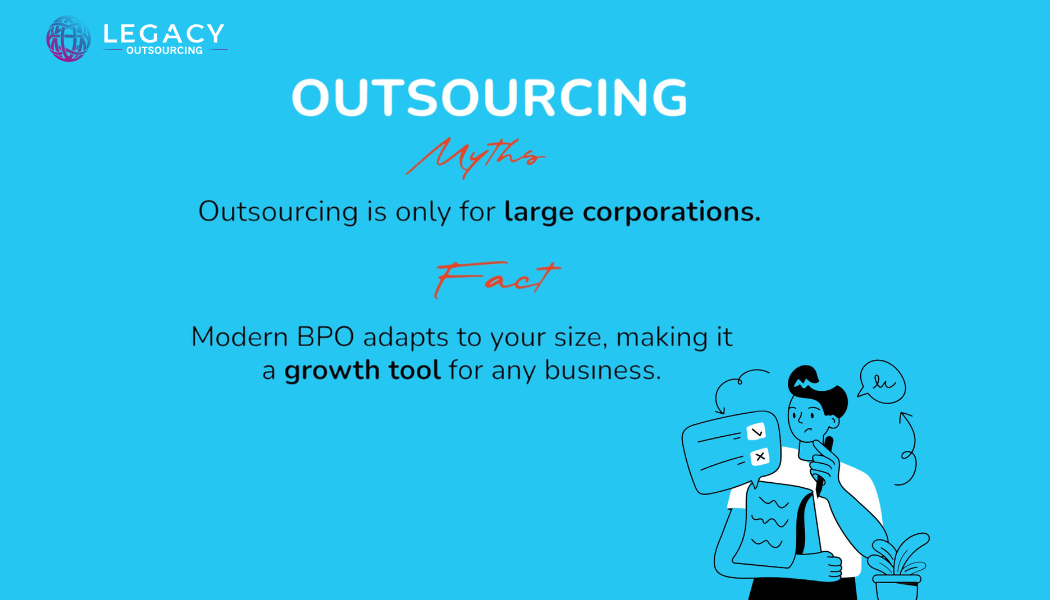
“BPO services are only for large corporations.”
But is that really a fact or just an outdated myth?
Let’s break it down.
Myth: BPO Services Are Only for Large Corporations
This belief has historical roots.
In the early stages of outsourcing, multinational corporations were the first adopters. Large-scale contracts and offshore centres dominated headlines, reinforcing the idea that BPO was reserved for enterprise-level organisations.
Smaller businesses often assumed:
- It’s too expensive
- It’s too complicated
- It’s too big for us
- We don’t have enough volume
But the BPO industry has evolved significantly.
Fact: Modern BPO Is Built for Scalability
Today’s BPO providers operate with flexibility at their core.
They support:
- Startups
- Small and medium-sized enterprises (SMEs)
- Growing mid-sized companies
- Established enterprises
You don’t need thousands of transactions or hundreds of employees to benefit.
You need structured processes and the willingness to optimise them.
What Has Changed in the BPO Landscape?
Flexible Engagement Models
Modern BPO is no longer tied to massive, long-term contracts.
Businesses can choose:
- Project-based outsourcing
- Function-specific support (such as accounts payable or payroll)
- Part-time outsourced professionals
- Dedicated remote teams
This makes BPO accessible not exclusive.
Technology Has Removed Traditional Barriers
Cloud-based systems, real-time reporting dashboards, secure data sharing, and automated workflows allow outsourcing partners to integrate seamlessly into your existing operations.
You maintain:
- Visibility
- Reporting access
- Oversight
- Control
Outsourcing no longer means losing touch with your processes.
Related Blog
Outsourcing Myths: “It’s Only for Large Corporations”
If you’re still questioning whether outsourcing is only suited for enterprise-level organisations, this related discussion dives deeper into one of the most persistent myths in the industry. It explores how modern outsourcing models are intentionally designed to scale with businesses at every stage from startups to growing SMEs.
Understanding this broader myth often clarifies why BPO is no longer size-dependent.
How BPO Strengthens Process Control
Another misconception is that outsourcing reduces internal control.
In reality, well-structured BPO enhances it.
At Legacy Outsourcing, finance functions such as accounts payable are built around defined workflows, approval hierarchies, exception management frameworks, and compliance alignment.
The objective isn’t just faster execution.
It’s:
- Fewer processing errors
- Stronger audit trails
- Clear accountability
- Better financial visibility
- Reduced compliance risk
BPO, when structured correctly, introduces discipline and clarity into business operations.
Why SMEs Often See Greater Impact
Smaller businesses often experience the greatest transformation through BPO.
Why?
Because internal teams are typically stretched.
Leadership often wears multiple hats from operations to finance to strategy.
By outsourcing specific functions, SMEs can:
- Free up leadership time
- Improve efficiency
- Strengthen compliance
- Scale with confidence
BPO becomes a growth enabler not just a cost-saving tactic.
When Should a Business Consider BPO?
You may be ready for BPO if:
- Your team feels overwhelmed
- Errors are increasing
- Compliance deadlines feel stressful
- Growth is outpacing internal systems
- You need expertise without long-term hiring risk
BPO isn’t about how big you are.
It’s about how ready you are to strengthen your processes.
Final Verdict: Myth or Fact?
Myth: BPO services are only for large corporations.
Fact: BPO services are scalable, flexible, and designed to support businesses at every stage.
The real question isn’t:
“Are we large enough for BPO?”
It’s:
“Are our current processes strong enough to support our next phase of growth?”
If there’s uncertainty there, BPO may be worth exploring.
FAQs: BPO & Business Size
What does BPO actually involve?
BPO (Business Process Outsourcing) involves delegating specific business functions — such as finance, payroll, HR, or customer support to a specialist external provider.
Can small businesses realistically benefit from BPO?
Yes. Modern BPO services are scalable and can be tailored to the needs and budgets of SMEs.
Is BPO expensive for smaller organisations?
Not necessarily. In many cases, outsourcing reduces overhead compared to hiring full-time internal staff.
Does outsourcing reduce control over operations?
No. With structured workflows, reporting systems, and compliance alignment, BPO can actually enhance visibility and accountability.
What functions are commonly outsourced?
Typical BPO services include:
- Accounts payable
- Payroll
- Bookkeeping
- HR administration
- Customer service
- IT support
- Data management
 Email: outsourcing@legacyinvestors.co.uk
 Website: legacyoutsourcing.co.uk
 Follow us: LinkedIn | Instagram